ML-KEM
Post-quantum key establishment for compatible protected communications. Not a digital-signature algorithm.
TVK Cryptographic Security Architecture (CSA): a roadmap combining standardized post-quantum cryptography, deterministic authorization, and a neural-inspired security evidence network.
A sufficiently capable quantum computer could undermine widely used public-key cryptography. Our migration architecture evaluates established post-quantum standards and hybrid deployments, with explicit compatibility checks for each blockchain, wallet and infrastructure protocol.
Post-quantum key establishment for compatible protected communications. Not a digital-signature algorithm.
Post-quantum digital signatures for systems and protocols that support them.
Hash-based signatures providing another standardized cryptographic construction.
Important: A classical on-chain wallet address does not become quantum-resistant solely through a PQ-encrypted app, tunnel or backup. Chain-level signature compatibility is independently assessed.
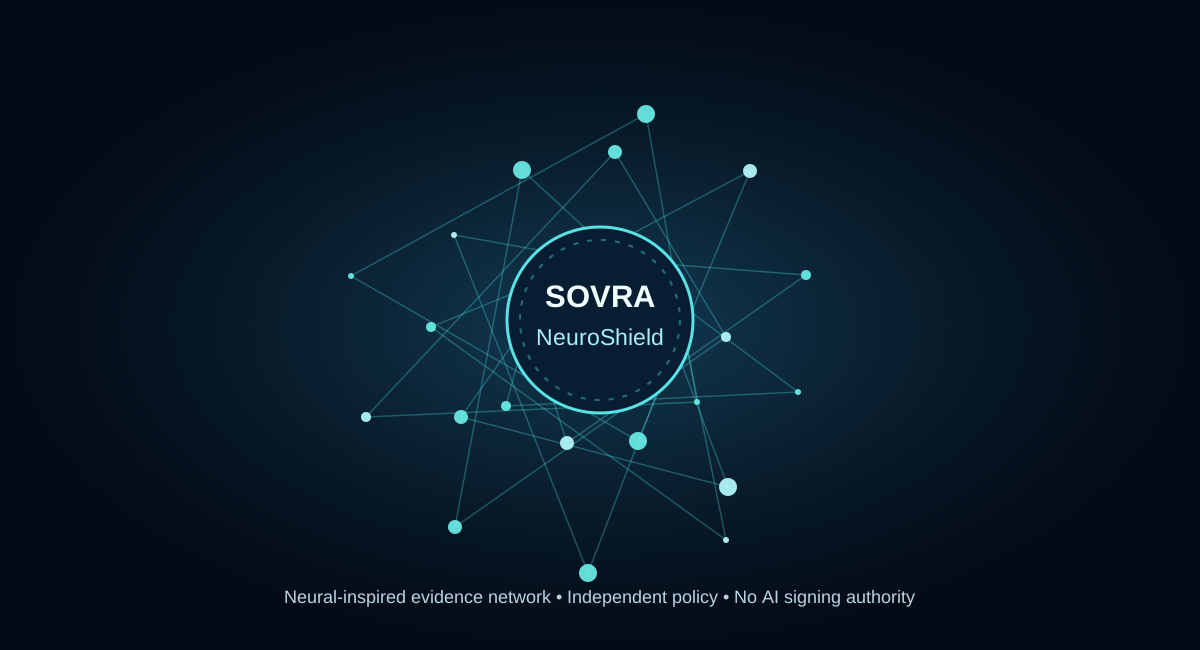
Independent specialized security analyzers act as connected evidence nodes. They share signed observations with a deterministic security kernel. Risk models may request extra checks; they are never permitted to manufacture approval or bypass cryptographic verification.
Conceptual information exchange only — sensor nodes possess no signing authority.
Critical checks cover identity, origin, chain and contract, destination, amount, asset, nonce, expiry, key state and explicit permission. Neural analysis supplements these checks; it cannot replace them.
Least privilege, strong authentication, session integrity and separation of duties.
Verified primitives, key lifecycle, crypto-agility and anti-downgrade design.
Intent verification, destination checks, replay resistance and recovery safeguards.
Controlled signing, allocation accuracy, reconciliation and independent review.
Scoped delegation, tool isolation, approval rules and emergency containment.
Server-side authorization, input validation, isolation and privacy controls.
Code provenance, secrets hygiene, dependency review and deployment evidence.
Evidence, adversarial tests, incident readiness, metrics and model-risk evaluation.
Our release methodology specifies threat modeling, secure design, negative and fuzz testing, source and dependency scanning, cryptographic protocol review, exact-deployment evidence and independently reviewed high-risk changes.
Control maturity is recorded individually as: designed, implemented, verified, independently assessed. Requirements are not presented as operational facts without evidence.
The open research question is whether signed, distributed neural-style security observations can improve detection and containment without introducing new wallet authority or unsafe AI dependencies.
Evaluation tracks false positives, latency, adversarial robustness, cryptographic compatibility, recovery times and demonstrable protection gains against conventional baselines.
No system can promise to be unhackable. We distinguish standardized cryptography from experimental research, and deployed implementations from proposed capabilities. Researchers can consult the official TVK product channels to report security concerns; do not submit secrets, private keys or wallet recovery phrases.
Technical references: NIST post-quantum standards · NIST KEM recommendations · NIST adversarial ML taxonomy.
The October 2026 Binance incident demonstrates the risk of an attacker exploiting a trusted withdrawal or transaction authorization service without necessarily extracting private keys. Our architecture therefore distinguishes cryptographic signing capability from independent business authorization.
Independently authenticated evidence and security controls
Independently authenticated evidence and security controls
Independently authenticated evidence and security controls
Independently authenticated evidence and security controls
Application and DevOps compromise must not independently authorize transfers. Isolated signer and policy approval boundaries are required.
Default-deny unapproved code delegation, validate bytecode hashes and operator authority, and rehearse immediate revocation.
Independently validate decoded call data, destination, asset, amount, chain, contract, nonce and expiry before signing.
Segregate treasury liquidity, limit hot balances, enforce transaction velocity thresholds and stop suspicious replenishment.
Reference: October 2026 incident reporting. Incident investigations and technical attribution remain subject to change.
Security must hold even if a developer workstation, application workload or withdrawal-request API is compromised. The sequence below describes mandatory independent barriers, not a guarantee that all barriers are presently implemented.
Refuse unapproved EIP-7702 authorizations, code hashes, operators and delegated contract capabilities.
Verify that the signer request independently matches the owner-approved amount, recipient, contract, chain, function and policy epoch.
Enforce combined exposure ceilings across hot wallets, chains, assets and rolling time windows. Suspend replenishment when integrity is uncertain.
Rehearse workstation compromise, malicious service-container requests, nonce spraying, signer API misuse and unauthorized wallet delegation on test environments.
An endpoint, developer token or service container must never gain transaction signing authority by itself. This flow describes how authorization is independently checked before signing.
Independently authenticated evidence and security controls
Independently authenticated evidence and security controls
Independently authenticated evidence and security controls
Independently authenticated evidence and security controls
Access the separate wallet application through its canonical domain. Never share a recovery phrase with a website or AI assistant.
The engineering lifecycle begins with algorithm and key inventory, determines compatibility, tests NIST-standardized cryptography, and verifies rollback and key recovery before deployment. Legacy on-chain signature mechanisms retain their original quantum exposure until the actual authorization protocol changes.
Independently authenticated evidence and security controls
Independently authenticated evidence and security controls
Independently authenticated evidence and security controls
Independently authenticated evidence and security controls
Identity, wallet, quantum-readiness and AI-behavior observers contribute provenance-bound security signals to an experimental evidence graph. Its outputs cannot approve transfers, remove cryptographic checks or access private signing keys.
Independently authenticated evidence and security controls
Independently authenticated evidence and security controls
Independently authenticated evidence and security controls
Independently authenticated evidence and security controls
Architecture is not evidence of implementation. The public register identifies candidate controls and explicitly marks their runtime effectiveness as not verified until relevant system-specific testing is completed.
View TVK CSA control-status register (machine-readable JSON)
Each verified future status must link to reproducible evidence, a deployment identifier and a scope of independent assessment. Customer secrets and privileged security implementation details remain private.